How to Hire Employees in the Philippines in 2026
A practical guide for foreign employers comparing direct hiring, recruitment agencies, managed staffing, EOR services, and Philippine entity setup.

Permhunt Team

What foreign employers need to know first
Before sourcing talent in the Philippines, decide whether you will engage people as employees or genuine independent contractors. Employees can be hired through your own registered Philippine entity or an Employer of Record, which becomes the local employer and administers payroll, tax, statutory contributions, and employment compliance.
An EOR is often the fastest option for a small initial team. Establishing a local entity can suit businesses planning larger, long-term operations. Direct contractor arrangements can work for independent project specialists, but they should not operate like disguised employment.
Three core engagement options
- Engage genuinely independent Philippine contractors directly from your existing overseas entity.
- Hire employees directly after incorporating and operationalizing your own Philippine entity.
- Hire employees through an EOR that already maintains a Philippine employing entity and payroll infrastructure.
Choose the right hiring channel
The practical comparison below separates candidate acquisition from the legal and operational structure used to employ or engage the person.
| Hiring route | Indicative pricing | Speed | Best use case | Main trade-off |
|---|---|---|---|---|
| Direct job boards | Free and paid listings are available. Sponsored pricing varies by platform, role, location, and campaign. | Fastest route to applicant flow once a listing is live. | High-volume hiring, employer-brand-led recruitment, easier-to-fill roles, and initial market testing. | You need internal capacity for screening, salary calibration, candidate communication, and compliance. |
| Recruitment agency | Specialist agencies commonly charge about 15%–30% of annual salary as a one-time success fee. | Can be faster than DIY when the brief is clear and interview feedback is prompt. | Specialist, mid-senior, confidential, and hard-to-fill positions. | Success fees are meaningful, and slow hiring-manager decisions still reduce speed. |
| Managed staffing / staff leasing | Recurring bill rates include provider margin. Public examples vary widely by role and service scope. | Provider-led setups often take one to several weeks. | Back-office, support, and recurring outsourced delivery where a bundled operating model is acceptable. | The bill rate embeds margin, with less direct control over employment and employer branding. |
| Employer of Record (EOR) | Philippines-focused public prices start around US$150 per employee monthly, but plans, inclusions, and percentage-based fees vary. | Usually faster than forming and operationalizing a local entity. | Foreign employers that want to hire local employees without incorporating first. | Ongoing per-head administration fees can become expensive as the team grows. |
| Your own Philippine entity | Registration, capital, payroll, tax, banking, and ongoing corporate administration costs apply. | Usually the slowest route because registration and employment infrastructure must be completed. | Long-term market entry, larger permanent teams, and operations requiring direct local control. | Higher setup burden and continuing corporate, payroll, tax, and labor administration. |
If you need speed and low setup friction, an EOR is usually the simplest employment route. If you need deep market mapping for niche roles, agency support can justify its fee. If you have employer brand and internal recruiting capacity, job boards are the lowest-cost sourcing channel. A sizable permanent operation can make a local entity more rational over time.
Understand the legal and payroll checklist
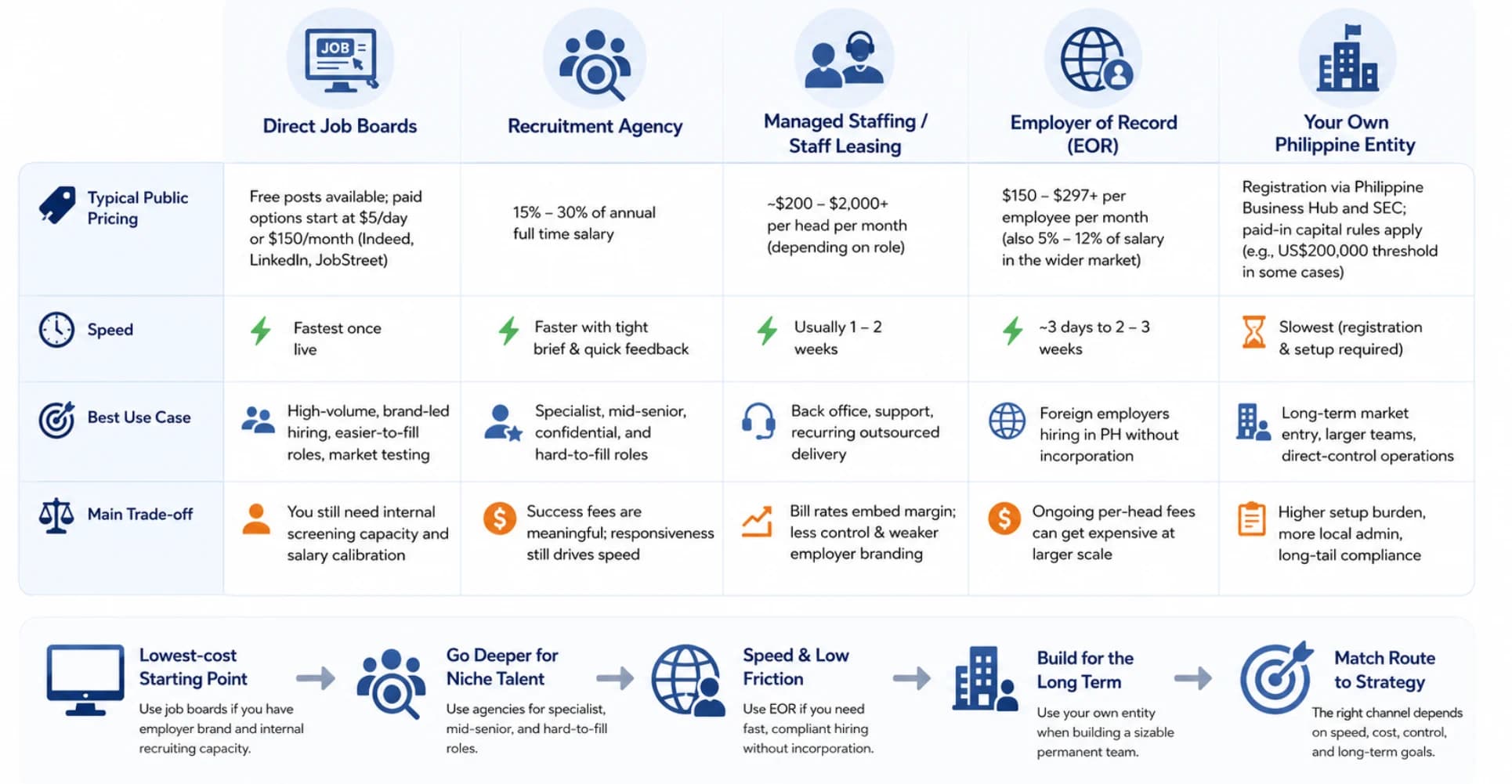
Employers commonly underestimate statutory registration, contribution remittance, probation rules, and 13th-month pay. Employees must be registered and reported correctly with SSS, PhilHealth, Pag-IBIG, and the BIR, with contributions withheld and remitted according to each agency's schedule.
Probationary employment generally cannot exceed six months. Covered rank-and-file employees who work at least one month during the calendar year receive 13th-month pay equal to at least one-twelfth of total basic salary earned, payable no later than December 24. The employer's compliance report is due by January 15 of the following year.
Foreign nationals working in Philippine roles are subject to separate AEP rules. The current framework requires timely filing after contract signing or appointment and labor-market test advertising. As of June 9, 2026, DOLE centralized AEP processing and issuance at its Central Office, so employers should check the latest filing channel before submission.
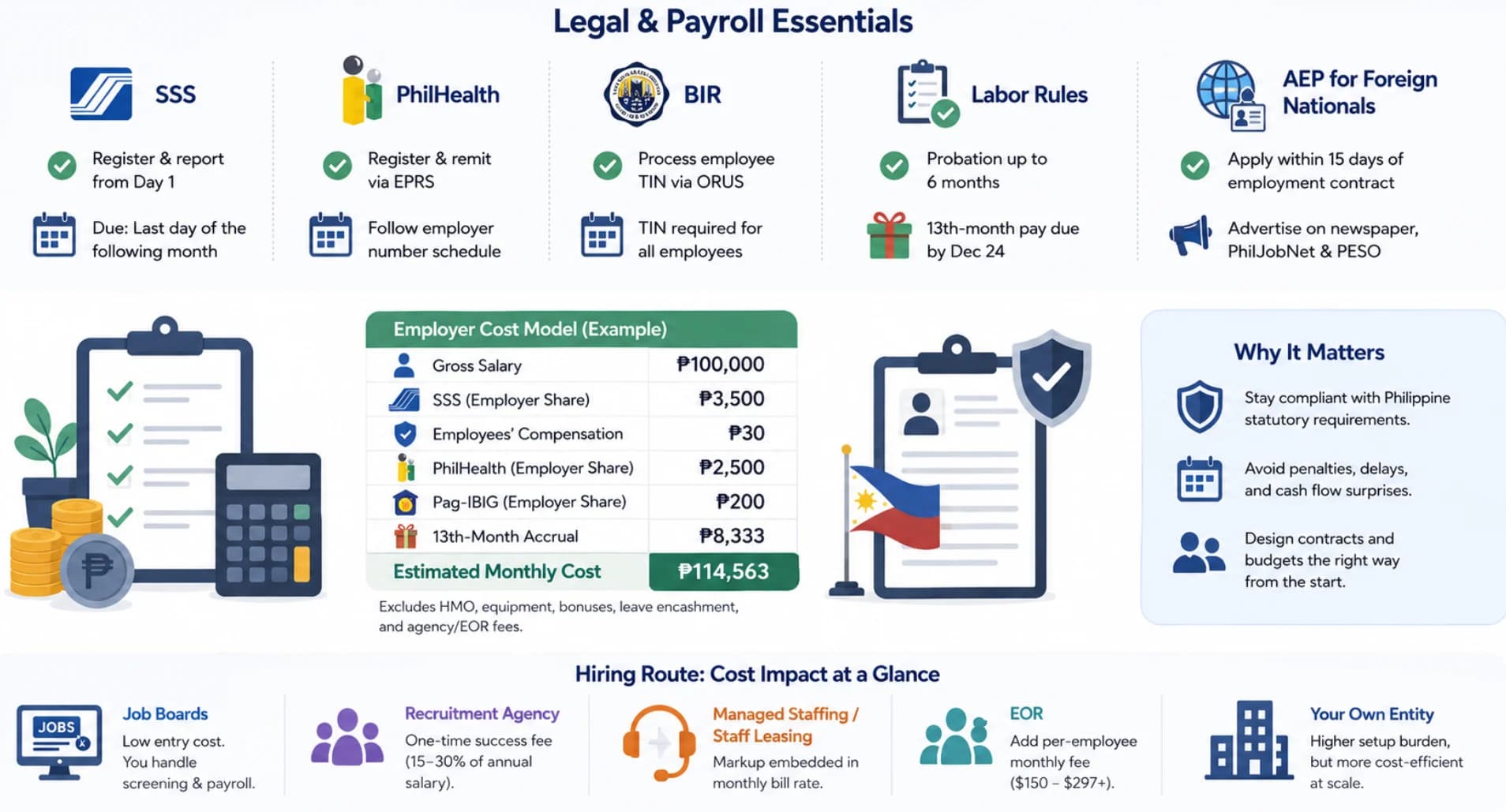
Example employer cost for a ₱100,000 monthly salary
This simplified model illustrates recurring statutory cash costs and should be recalculated against current agency tables before payroll is finalized.
| Cost item | Estimated monthly employer cost | Basis |
|---|---|---|
| Gross salary | ₱100,000 | Contracted monthly gross pay |
| SSS employer share | ₱3,500 | 10% employer share, capped at the ₱35,000 Monthly Salary Credit |
| Employees’ Compensation | ₱30 | Employer-only EC contribution at the applicable upper band |
| PhilHealth employer share | ₱2,500 | Half of the 5% premium at the ₱100,000 income ceiling |
| Pag-IBIG employer share | ₱200 | 2% employer contribution using the current ₱10,000 fund salary basis |
| 13th-month accrual | ₱8,333 | One-twelfth of annual basic salary accrued monthly |
| Estimated monthly cash compensation cost | ₱114,563 | Excludes HMO, equipment, bonuses, leave encashment, and provider fees |
Run a faster hiring process for tech roles
Strong technology candidates often move quickly. Keep the process to a structured screen, one role-relevant technical assessment, and a final decision round wherever possible, with same-week feedback after each stage.
| Stage | Typical target | What matters most |
|---|---|---|
| Role scoping | 1–2 days | Salary band, work setup, reporting line, responsibilities, and interview scorecard |
| Sourcing | 3–10 days | Use job boards for volume and agency or direct outreach for specialist talent |
| Shortlist to final interview | 5–10 days | Keep calendars tight, consolidate stages, and align decision-makers |
| Offer to signed contract | 2–5 days | Pre-agree compensation guardrails, approvals, and notice-period posture |
| Onboarding | Several days to several weeks | Timing depends on entity, EOR, permit, payroll, and documentation requirements |
For technical assessments, test practical stack fluency rather than generic puzzle solving. Short work samples, live debugging, architecture walkthroughs, and focused case exercises are better aligned with roles requiring cloud platforms, APIs, CI/CD, testing, source control, SQL, React, .NET, Azure, and clear documentation.
Remote, hybrid, contractor, and employee setups
Remote and hybrid roles are not automatically paid more, but they are frequently attached to harder-to-fill specialist positions. The premium usually comes from scarce capability, technical ownership, global hours, or domain complexity rather than work location alone.
Contractor arrangements require care. Philippine jurisprudence applies the four-fold and economic-dependence tests, with control over the means and methods of work carrying particular weight. The words “independent contractor” in an agreement do not decide the legal outcome.
Use contractors for clearly scoped project work performed with genuine independence. Use direct employment, an EOR, or a managed staffing model for recurring roles involving supervision, internal systems, performance management, and long-term dependency.
What we see in the market
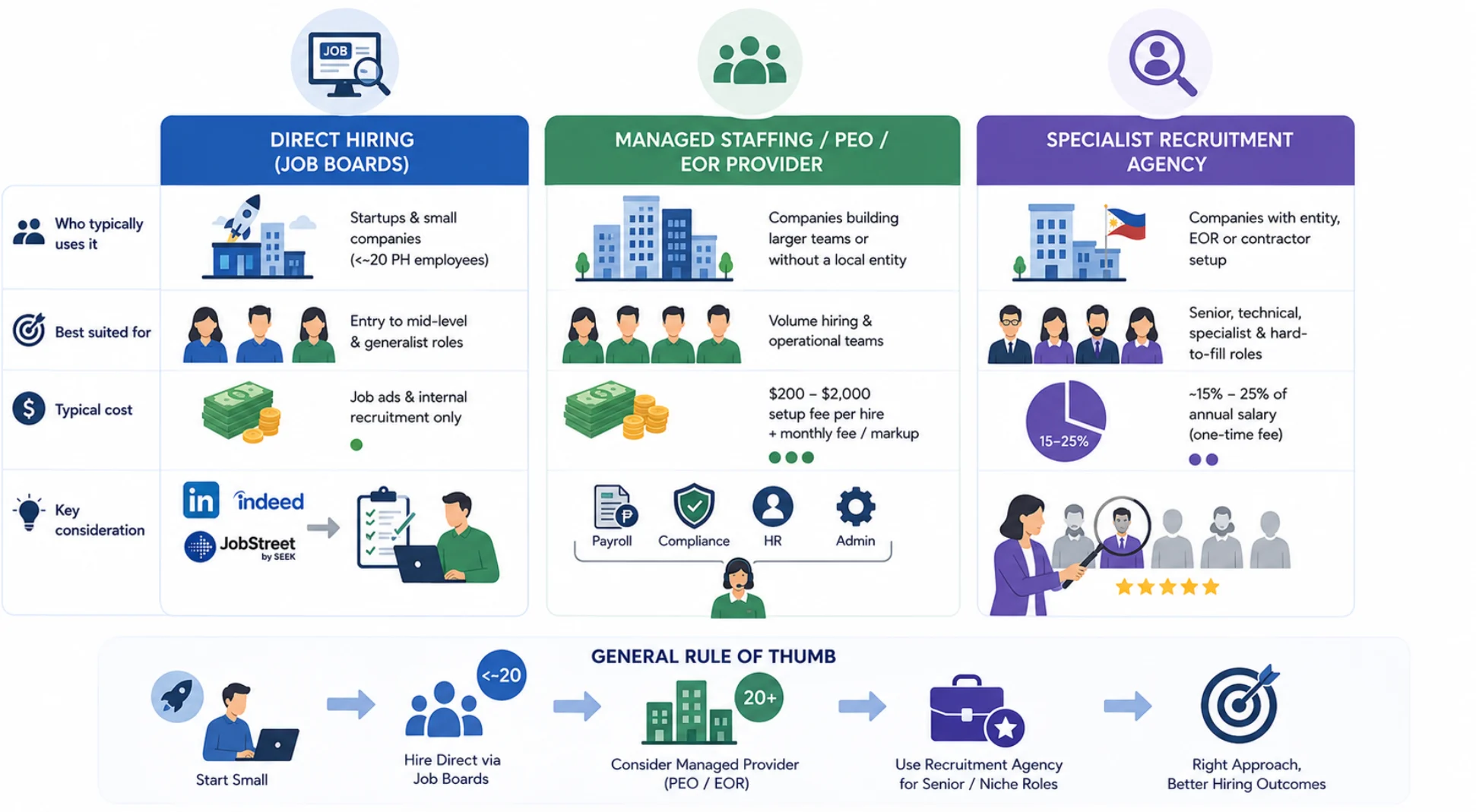
| Hiring option | Who typically uses it | Best suited for | Typical cost | Key consideration |
|---|---|---|---|---|
| Direct hiring through job boards | Startups and companies with internal recruiting capacity | Entry-level, mid-level, and generalist roles | Advertising and internal recruitment costs | Usually the lowest-cost route, but the employer owns advertising, screening, interviewing, candidate follow-up, and employment setup. |
| Managed staffing, PEO, or EOR provider | Companies building larger teams or hiring without a local entity | Volume hiring, operational teams, and fully managed employment | Setup or recruitment fees plus a recurring monthly fee or payroll markup | Can manage employment, payroll, compliance, HR, and administration, but usually carries the highest recurring cost. |
| Specialist recruitment agency | Companies with an entity, EOR, or contractor structure that need sourcing support | Senior, technical, specialist, confidential, and difficult-to-fill roles | Commonly 15%–30% of annual salary as a one-time success fee | Provides proactive headhunting, screening, and access to candidates who may not be actively applying. |
Smaller companies often begin with direct job-board hiring. Managed providers become more attractive as administration grows, while specialist agencies remain useful at any team size when a position is senior, technical, confidential, or difficult to fill.
Build your Philippine team
Get a role-specific hiring and salary plan
Permhunt recruits technical and specialist talent across the Philippines, from calibration and market mapping through shortlist and offer.
Quick answers
Frequently asked questions
Can a foreign company hire an employee in the Philippines without a local entity?
Yes. An Employer of Record can become the local legal employer and administer employment, payroll, tax, and statutory contributions while the foreign company directs the employee’s day-to-day work within the agreed model.
Is hiring a contractor the same as hiring an employee?
No. A genuine contractor operates independently. Philippine courts look at the actual relationship, particularly control, payment, dismissal, and economic dependence. A contractor label does not override employee-like working conditions.
How much should an employer budget above gross salary?
Budget for employer statutory contributions, 13th-month pay, benefits, equipment, leave-related costs, and any recruitment, staffing, or EOR fees. The exact total depends on salary, benefits, location, and employment route.
When does forming a Philippine entity make sense?
An entity becomes more compelling when the company expects a sizable, durable local operation and wants direct control over employment and administration. The decision should account for registration, ownership rules, capital, tax, banking, and ongoing compliance.
Sources and references
- Social Security System: current contribution rules
- PhilHealth: premium contribution guidance
- Pag-IBIG Fund: employer and member payment guidance
- DOLE: 13th-month pay coverage and deadlines
- DOLE: employment permit rules for foreign nationals
- DOLE: centralized AEP processing effective June 2026
- Supreme Court: employee and independent contractor tests
- SEC: Philippine company registration services
- Public EOR pricing example: Comply.ph
- Public EOR pricing example: Telework PH
Related Topics

About Permhunt Team
Expert in remote hiring and Filipino talent acquisition with over 10 years of experience helping companies build successful remote teams.