
Holiday Pay in the Philippines: Rules, Rates & Computation
A practical employer guide to Philippine holiday pay, including regular and special holiday rates, overtime formulas, eligibility rules, worked examples, and payroll compliance steps.

Permhunt Team

Photo by Behnam Norouzi on Unsplash
Executive summary
Philippine law distinguishes regular holidays, special non-working days, and occasional special working days. Covered employees generally receive 100% of their daily wage for an unworked regular holiday when the day-before condition is met, 200% for the first eight hours worked, and no pay for an unworked special non-working day unless a more favorable policy, practice, or agreement applies. The sections below explain the rates, worked examples, eligibility rules, and payroll controls employers most often need.
Holiday pay protects the income of covered Philippine employees during regular holidays and sets minimum premiums when work is performed on regular holidays or special non-working days. The correct calculation depends on the legal classification of the day, whether the employee worked, whether it was also a rest day, and whether overtime was rendered.
This guide translates the principal rules into practical payroll formulas. Annual holiday calendars can change through presidential proclamations, and DOLE may issue date-specific advisories, so employers should verify the classification of each date before payroll is finalized.
What is holiday pay?
Article 94 of the Labor Code provides covered workers with their regular daily wage during regular holidays, subject to statutory rules and exclusions. When an employee works on a regular holiday, the minimum rate for the first eight hours is 200% of the basic daily wage.
Special non-working days follow a different framework. The default is no work, no pay unless a more favorable policy, established practice, or collective bargaining agreement applies. When work is performed, a premium is added to the basic wage.
2026 holidays at a glance
Proclamation No. 1006 lists ten dated regular holidays for 2026, with Eid’l Fitr and Eid’l Adha subsequently proclaimed for March 20 and May 27. That produces 12 nationwide regular holidays for 2026. Election years may add a regular holiday for polling day through the applicable law or proclamation, so payroll teams should always check the current annual calendar and later issuances.
Regular holidays
- January 1New Year’s Day
- April 2Maundy Thursday
- April 3Good Friday
- April 9Araw ng Kagitingan
- May 1Labor Day
- June 12Independence Day
- August 31National Heroes Day
- November 30Bonifacio Day
- December 25Christmas Day
- December 30Rizal Day
- March 20Eid’l Fitr
- May 27Eid’l Adha
Special non-working days
- February 17Chinese New Year
- April 4Black Saturday
- August 21Ninoy Aquino Day
- November 1All Saints’ Day
- November 2All Souls’ Day
- December 8Feast of the Immaculate Conception of Mary
- December 24Christmas Eve
- December 31Last Day of the Year
This national list does not include local holidays or later special proclamations. Update the section when the annual holiday proclamation changes.
Regular, special non-working, and special working days
Regular holiday
Paid when eligible
100% when not worked and eligible; 200% for the first eight hours worked.
Special non-working
No work, no pay by default
130% for the first eight hours worked; 150% when it is also a rest day.
Special working
An ordinary workday
No special-day premium; ordinary attendance, leave, and pay rules apply.
Who is entitled to holiday pay?
Holiday pay generally covers non-managerial employees in private employment, including regular, probationary, casual, project-based, and part-time employees when an employer-employee relationship exists. Monthly-paid employees are also covered, although the benefit may already be built into the salary structure.
Coverage is subject to statutory and implementing-rule exclusions. These may include:
- Government employees covered by civil-service rules
- Managerial employees who meet the statutory and implementing-rule tests
- Field personnel and other employees whose time and performance are unsupervised under the applicable rules
- Domestic workers and persons in the personal service of another, subject to the rules governing their employment
- Employees of qualifying retail and service establishments regularly employing fewer than 10 workers
- Other workers excluded under the Labor Code or its implementing rules based on the actual employment arrangement
Job title alone does not determine an exclusion. Employers should assess the employee's actual duties, authority, supervision, and working arrangement.
Regular holiday pay rates
The following formulas use the employee's basic daily wage and assume an eight-hour standard workday.
| Scenario | Minimum rate | How it works |
|---|---|---|
| Holiday not worked | 100% of the basic daily wage | Subject to coverage and the day-before eligibility rule |
| First eight hours worked | 200% of the basic daily wage | Double pay |
| First eight hours worked on a rest day | 260% of the basic daily wage | 200% holiday rate × 130% rest-day factor |
| Overtime on a regular holiday | 260% of the ordinary hourly rate per overtime hour | Ordinary hourly rate × 200% × 130% |
| Overtime when the holiday is also a rest day | 338% of the ordinary hourly rate per overtime hour | Ordinary hourly rate × 200% × 130% × 130% |
Special non-working day rates
A more favorable company policy, established practice, employment agreement, or CBA overrides the statutory minimum.
| Scenario | Minimum rate | How it works |
|---|---|---|
| Special non-working day not worked | No work, no pay | Unless a more favorable policy, practice, or CBA applies |
| First eight hours worked | 130% of the basic daily wage | Basic wage plus a 30% premium |
| First eight hours worked on a rest day | 150% of the basic daily wage | Basic wage plus a 50% premium |
| Overtime on a special non-working day | 169% of the ordinary hourly rate per overtime hour | Ordinary hourly rate × 130% × 130% |
| Overtime when the special day is also a rest day | 195% of the ordinary hourly rate per overtime hour | Ordinary hourly rate × 150% × 130% |
Worked holiday-pay examples
These examples isolate the statutory holiday component and do not include allowances, night-shift differential, or other company benefits.
| Scenario | Calculation | Pay |
|---|---|---|
| Regular holiday worked for eight hours | ₱1,000 × 200% | ₱2,000 |
| Regular holiday worked on a rest day | ₱1,000 × 200% × 130% | ₱2,600 |
| Regular holiday with two overtime hours | Base: ₱1,000 × 200% = ₱2,000; OT: (₱1,000 ÷ 8) × 200% × 130% × 2 = ₱650 | ₱2,650 |
| Special non-working day worked for eight hours | ₱800 × 130% | ₱1,040 |
| Special non-working day worked on a rest day | ₱800 × 150% | ₱1,200 |
The day-before eligibility rule
A covered employee who does not work on a regular holiday is generally entitled to 100% holiday pay when they worked or were on approved paid leave on the workday immediately before the holiday.
If the day immediately before the holiday is a non-working day in the establishment or the employee's scheduled rest day, eligibility generally depends on the employee having worked or been on approved paid leave on the workday immediately before that non-working day or rest day. Attendance and leave records should therefore be finalized before payroll is processed.
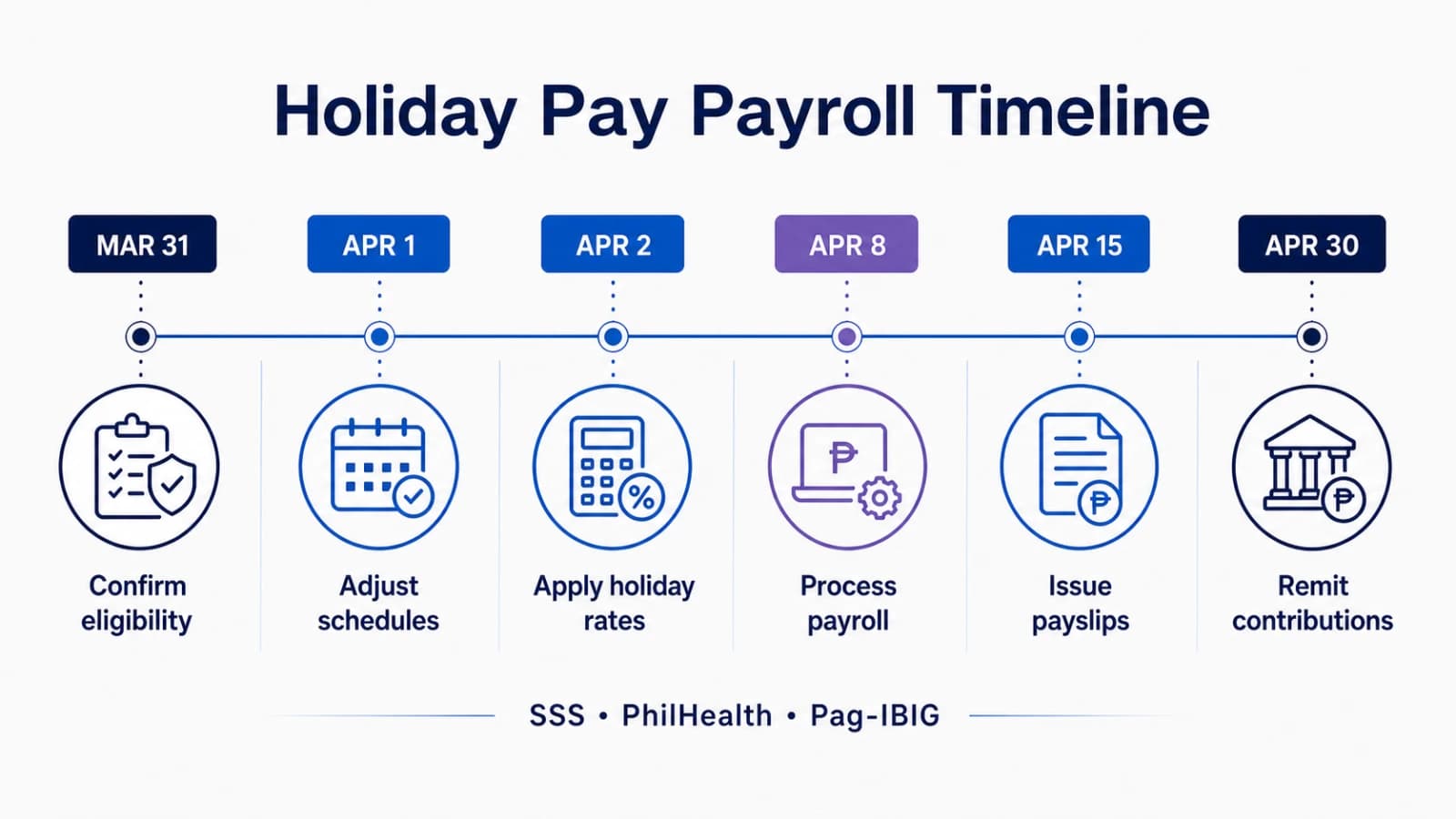
Holiday payroll timeline
The dates below are illustrative. The workflow shows the controls an employer can apply before, during, and after a holiday payroll cycle.
Employer obligations and payroll records
Underpayment can lead to employee complaints, back-pay orders, and other consequences. Accurate records are the strongest practical control because the correct rate depends on the holiday classification, attendance, rest-day schedule, and hours actually worked.
- Confirm whether the date is a regular holiday, special non-working day, or special working day under the applicable proclamation and DOLE advisory.
- Identify covered employees and check the workday or paid-leave status immediately before a regular holiday.
- Confirm whether the holiday also falls on each employee’s scheduled rest day.
- Separate the first eight hours from overtime and apply the correct compounded premium.
- Reconcile attendance, approved leave, rest-day schedules, and payroll inputs before the cut-off.
- Show the holiday and overtime components clearly in payroll records and payslips.
- Apply any more favorable company policy, established practice, employment contract, or collective bargaining agreement.
- Recheck current DOLE advisories whenever a new holiday or pay rule is announced.
Practical holiday-pay best practices
- Plan for the calendar: Load proclaimed holidays into payroll and workforce scheduling systems before the year begins, then update them when new proclamations are issued.
- Communicate early: Tell employees which dates are working, non-working, or rest days and set clear timesheet deadlines.
- Automate carefully: Configure payroll software for compounded holiday, rest-day, and overtime factors, then test the results against manual examples.
- Audit samples: Review several payroll records after each holiday cycle, especially employees who worked overtime or whose rest day coincided with the holiday.
- Escalate unusual cases: Confirm double holidays, alternative workweeks, output-based pay, and disputed employee classifications with qualified Philippine payroll or legal advisers.
Hiring in the Philippines?
Build the role and employment budget with confidence
Permhunt can help you define the role, benchmark the market, and recruit qualified permanent talent across the Philippines.
Quick answers
Frequently asked questions
What is the difference between a regular holiday and a special non-working day?
Covered employees generally receive 100% of their basic daily wage for an unworked regular holiday when the eligibility conditions are met. A special non-working day normally follows the no-work, no-pay principle unless a more favorable company policy, practice, or collective bargaining agreement applies.
How much is the pay when an employee works on a regular holiday?
The minimum for the first eight hours is 200% of the basic daily wage. If the regular holiday also falls on the employee’s rest day, the minimum becomes 260%.
How much is the pay when an employee works on a special non-working day?
The minimum for the first eight hours is 130% of the basic daily wage. If the special non-working day also falls on the employee’s rest day, the minimum becomes 150%.
How is overtime calculated on a regular holiday?
For overtime on a regular holiday, multiply the ordinary hourly rate by 200% and then by 130% for each overtime hour. If the holiday is also a rest day, apply the additional rest-day factor before the overtime premium.
What is the day-before rule?
For an unworked regular holiday, eligibility generally depends on the employee having worked or been on approved paid leave on the workday immediately before the holiday. When that preceding day is a non-working day or scheduled rest day, the test looks to the workday immediately before it.
Does a special working day have a holiday premium?
No. A special working day is treated as an ordinary working day. Work is paid at the ordinary rate, and an employee who does not work is handled under the employer’s normal attendance, leave, and wage rules.
Official sources and further guidance

About Permhunt Team
Expert in remote hiring and Filipino talent acquisition with over 10 years of experience helping companies build successful remote teams.