
Philippines Job Board Guide 2026: Where to Post Jobs
Compare the leading job boards in the Philippines for 2026, including reach, pricing, strengths and the best channel mix for each type of hire.

Permhunt Team
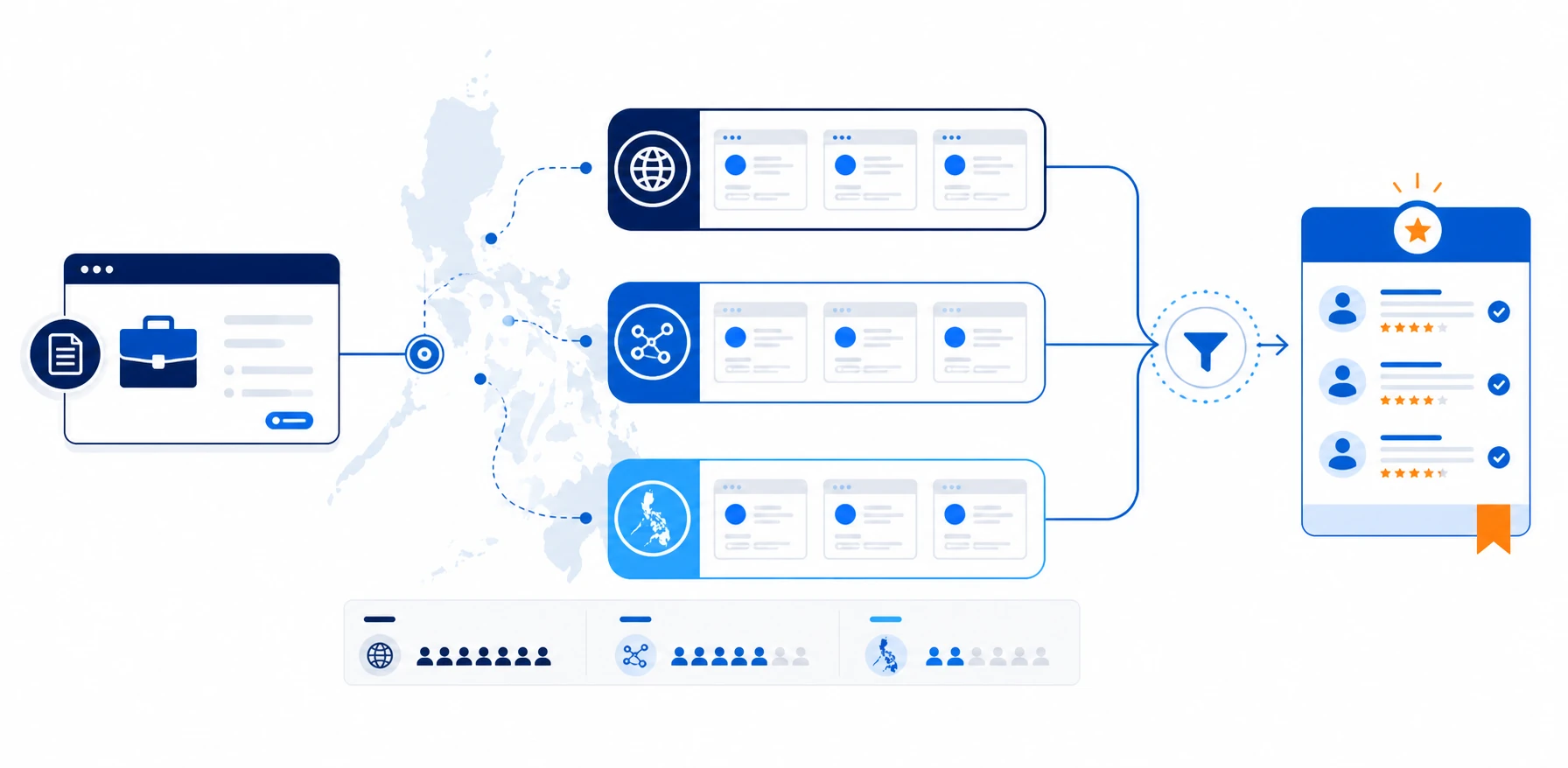
For most employers hiring in the Philippines in 2026, JobStreet and LinkedIn should be treated as the two Tier 1 channels — but they solve different hiring problems. JobStreet is strongest for active local jobseekers, while LinkedIn is typically more effective for senior, specialist and passive professional talent.
Indeed is a strong mass-market alternative, while Philippines-focused platforms such as Permworks can give employers a lower-cost way to reach Filipino professionals directly. The right choice depends on the seniority of the role, candidate scarcity, budget and how much internal recruitment capacity you have.
Philippine job-board market at a glance
There is no single audited public dataset that measures Philippine job-board market share by successful hires. Registered users, website visits, job applications and actual placements are different metrics, so employers should avoid comparing them as if they are identical.
- Indeed: Semrush estimated approximately 4.52 million Philippine website visits in June 2026, and Similarweb ranked Indeed first in its Philippine Jobs & Employment category in July 2026.
- JobStreet: Semrush estimated approximately 2.8 million Philippine website visits in June 2026. JobStreet separately reports more than 11.6 million registered Filipino candidates.
- LinkedIn: The latest available Digital 2026 reporting indicates approximately 22 million registered LinkedIn members in the Philippines. This is a membership figure, not a monthly-active-jobseeker figure.
- Permworks: Permworks publicly reports more than 3,000 placements and 500 companies using the platform.
Best job boards in the Philippines for employers
Here's how each of the main platforms stacks up, and where each one tends to work best.
| Platform | Tier | Typical pricing | Reach / audience | Best for |
|---|---|---|---|---|
| JobStreet by SEEK | Tier 1 | Lite: free. Paid Basic, Advanced and Premium options available; pricing varies by vacancy and product. | 11.6M+ registered Filipino candidates; ~2.8M PH web visits in June 2026. | Entry-level to senior professional roles; operations, finance, BPO, IT and general corporate hiring. |
| Tier 1 | Free posting may be available subject to limits. Promoted jobs use variable daily or total budgets. | ~22M registered PH members; monthly active jobseeker count not publicly disclosed. | Senior professionals, software engineering, DevOps, cloud, data, AI, cybersecurity, managers and executives. | |
| Indeed | Tier 2 | Free postings available subject to policies. Sponsored jobs use variable budgets rather than one fixed PH price. | ~4.52M PH web visits in June 2026; #1 Similarweb Jobs & Employment site in July 2026. | High-volume recruitment, general professional roles and additional reach beyond JobStreet. |
| Permworks | Tier 2 - PH specialist | Lite: free; Basic: US$59/job; Premium: US$79/job; Professional: US$99/month for unlimited postings. | 3,000+ placements and 500+ companies reported; monthly visitor figure not publicly disclosed. | International employers hiring Filipino professionals directly; startups and cost-conscious employers. |
| Kalibrr | Tier 2 | Free hiring workspace available; advanced sourcing and visibility via custom paid plans. | ~117K PH web visits in June 2026; platform reports 8M+ talent across its wider network. | Graduate to mid-level white-collar roles and employers wanting a built-in recruiting workflow. |
| Bossjob | Tier 3 / additional channel | Current employer documentation indicates a free subscription; paid boosting and talent-search credits may be available. | Comparable PH monthly active-user figure not publicly disclosed. | Supplementary sourcing, frontline/general roles and chat-led recruitment. |
JobStreet: the strongest general-purpose starting point
Best for: Entry-level to senior professional roles — operations, finance, customer service, BPO, IT, sales and general corporate hiring.
Why use it: Free Lite ads suit easier-to-fill or non-urgent roles, while paid Basic, Advanced and Premium options add visibility, targeting and candidate-matching.
Watch out for: Popular roles can attract a large number of applicants — use clear salary ranges, essential requirements and screening questions to cut down on irrelevant applications.
For an employer with one advertising budget and a conventional Philippine vacancy, JobStreet is usually the safest first choice. It also gives employers access to Talent Search and recruitment-system integrations, letting larger hiring teams go beyond passive job advertising.
LinkedIn: strongest for senior and niche professional talent
Best for: Senior professionals and specialist technology roles — software engineers, DevOps and cloud, data engineers, cybersecurity specialists, product leaders, engineering managers and technology executives.
Why use it: Lets employers identify candidates by employment history, skills, employer and network — including people who aren't actively applying for jobs.
Watch out for: Promoted-job pricing is performance-based, not a fixed PH fee — actual cost depends on the vacancy, location, competition and candidate demand.
LinkedIn should normally sit beside JobStreet rather than replace it. For harder roles, employers can advertise while proactively searching and approaching relevant candidates directly.
Indeed: strong for reach and applicant volume
Best for: High-volume recruitment and general professional hiring.
Why use it: Free postings with sponsored options for extra visibility, substantial Philippine traffic, and a broad ATS ecosystem that suits structured recruitment systems.
Watch out for: The same trade-off as any high-volume channel — more applications don't automatically mean more qualified candidates. Track interviewable applicants, not just totals.
Indeed deserves a place in most broad Philippine sourcing strategies. Current third-party traffic estimates show substantial Philippine usage, and employers can publish qualifying jobs for free or sponsor them for greater visibility.
Permworks: a lower-cost Philippines-focused option
Best for: International employers hiring Filipino professionals directly, plus startups and cost-conscious employers.
Why use it: Transparent pricing — free to start, US$59 or US$79 for one-off ads, or US$99/month for unlimited postings — plus applicant management, candidate messaging, priority placement, email distribution and AI-powered candidate feedback.
Watch out for: Comparable monthly active-user data isn't publicly available, so treat it as a specialist Philippines channel rather than a replacement for the largest platforms.
Permworks is built specifically around connecting employers with Filipino talent and is particularly relevant to international companies hiring directly in the Philippines.
Kalibrr: useful for white-collar and early-career hiring
Best for: Supplementary sourcing, frontline and general roles, and chat-led recruitment.
Why use it: Free subscription for employers, with paid boosting and talent-search credits available for extra reach.
Watch out for: Comparable PH monthly active-user figures aren't publicly disclosed — treat it as a supplementary channel rather than a primary one.
Kalibrr remains relevant for graduate, junior and mid-level white-collar hiring, and its free product covers the basics of job creation and applicant management.
Bossjob: useful for high-volume and blue-collar hiring
Best for: Supplementary sourcing, frontline, blue-collar, and general roles, with a strong chat-based recruitment approach.
Why use it: Free employer posting options, with paid features available for increased visibility and access to additional candidate pools.
Watch out for: Comparable PH monthly active-user figures aren't publicly disclosed — treat it as a supplementary channel rather than a primary sourcing platform.
Bossjob is particularly useful for high-volume, frontline, and general hiring, while its chat-first approach can help recruiters engage candidates more directly.
Before you post: what Philippine law says about job ads
Republic Act 10911, the Anti-Age Discrimination in Employment Act, makes it illegal to state an age preference or limitation in a job ad in the Philippines — in print, online or on any job board. Employers also cannot require an applicant to declare their age or birth date during the application process, or decline an application because of age.
Penalties range from a P50,000 to P500,000 fine, with possible imprisonment for repeat offences. In practice, this means dropping any wording like “25-35 years old preferred” from your ad, and not adding an age or birth date field to your own application form beyond what's legally required for the role.
Job ad checklist: what actually cuts down irrelevant applications
- Give a salary range: even a band, rather than “negotiable.” It narrows down who applies and cuts down on candidates who'd walk away over compensation later in the process.
- State the work setup clearly: onsite, hybrid or remote. This is one of the first things candidates screen for, and leaving it out tends to bring in applicants who wouldn't have applied if they'd known upfront.
- Separate must-have from nice-to-have requirements: so screening doesn't reject strong candidates over a wishlist item, and applicants can self-select instead of mass-applying to anything that vaguely matches.
Which job board should you use for each type of hire?
| Hiring need | Recommended channel mix | Practical approach |
|---|---|---|
| Entry-level / fresh graduate | JobStreet + Indeed; add Permworks where relevant | Prioritise applicant volume and cost. Free or low-cost ads can be sufficient when requirements are common. |
| General mid-level professional | JobStreet first; LinkedIn + Indeed second | Use JobStreet for active local candidates and LinkedIn to broaden professional reach. |
| BPO, operations or volume hiring | JobStreet + Indeed | Optimise for volume, fast screening and clear salary, shift and location details. |
| Mid-level software / IT | JobStreet + LinkedIn + Permworks | Advertise while also identifying relevant profiles instead of relying only on inbound applications. |
| Senior software / DevOps / cloud / data | LinkedIn + JobStreet + proactive sourcing | Candidate quality matters more than raw application volume. Passive candidates become increasingly important. |
| Cybersecurity / AI / highly niche technical | LinkedIn + specialist headhunting; JobStreet as supplementary reach | Do not assume a job ad alone will uncover the strongest candidates. |
| Engineering manager / CTO / executive | LinkedIn + specialist search / headhunting | Confidential and proactive search typically matters more than mass applications. |
| First Philippine hires for an international employer | JobStreet + Permworks + LinkedIn | Test direct sourcing inexpensively, but decide who will manage screening, contracts, payroll and compliance before offer stage. |
Free vs paid job ads
Start with free advertising when the role has a large natural candidate pool and urgency is low. JobStreet, Indeed, Permworks and Kalibrr all provide some form of free employer entry point in 2026.
Paid promotion becomes easier to justify when the role is urgent, free visibility is not producing enough qualified applicants, competitors are advertising similar positions, or the cost of leaving the role vacant is greater than the advertising budget.
A US$300 campaign that produces 15 genuinely interviewable candidates can be more efficient than a free ad that produces 300 applications and only two viable profiles.
Measure applicant quality, not applicant count
Track each channel through the full hiring funnel:
This is especially important for technology hiring. A strong applicant should match the actual requirements of the role — technical stack, architecture or production exposure, cloud environment, scale, leadership scope, stakeholder communication, working-hours requirements and compensation expectations.
When job boards are not enough
A job board is the cheapest hiring channel when it works. For many startups and smaller employers hiring entry-level, mid-level or relatively common roles, posting directly and managing recruitment internally is the logical first step.
The economics change as a role becomes harder to find. A senior DevOps engineer with a specific cloud stack, a cybersecurity specialist, an experienced data engineer, an AI engineer or a technology leader may generate few suitable inbound applicants because the target population is smaller and many of the strongest candidates are already employed.
At that point, the employer can invest more internal recruiter time into proactive sourcing, use a specialist recruitment or headhunting agency, or move to a broader managed staffing solution where recruitment and employment administration are bundled together. The right option depends on whether your bottleneck is finding the candidate, employing the candidate, or both.
The bottom line
Don't post on every job board that exists. Pick one or two channels that fit the role, track how many applicants are actually qualified, and only add another channel if the first ones fall short.
A large number of applications is not the same as a large number of good candidates. If a channel is producing plenty of applications but very few suitable ones, the issue is usually the sourcing strategy, not the number of job boards in use.
This gap tends to be widest for harder tech roles — senior engineers, DevOps, cybersecurity, AI specialists and technology leaders — where the strongest candidates often aren't browsing job boards at all. If you're hiring for one of these roles, Permhunt can help you reach candidates that job boards typically miss.
Need more than inbound applicants?
Build a role-specific Philippine hiring strategy
Permhunt combines local market knowledge with proactive sourcing for technical, specialist and leadership roles across the Philippines.
Quick answers
Frequently asked questions
What is the best job board in the Philippines for employers?
For broad direct hiring, JobStreet is one of the strongest overall starting points because of its large Philippine candidate database, active-jobseeker focus and free entry option. LinkedIn is typically the best complement for senior, specialist and professional roles.
Is JobStreet free for employers in the Philippines?
Yes. JobStreet offers free Lite job ads. Paid Basic, Advanced and Premium products provide greater visibility, targeting and recruitment functionality, with pricing varying by vacancy and product.
Is LinkedIn free for posting jobs in the Philippines?
LinkedIn can make free job posting available subject to eligibility and posting limits. Employers can also promote jobs using a daily or total budget, with pricing varying according to the role, location, competition and candidate demand.
Is Indeed free for Philippine employers?
Indeed allows qualifying jobs to be posted for free subject to its terms, quality standards and usage limits. Employers can sponsor vacancies for additional visibility using a variable advertising budget.
Which job board is best for hiring software engineers in the Philippines?
For junior and mid-level software roles, JobStreet and LinkedIn are a strong combination, with Permworks and Indeed providing additional reach. For senior engineers or niche technology stacks, LinkedIn and proactive sourcing become increasingly important.
Which platform is best for senior hires in the Philippines?
LinkedIn is generally the strongest job-platform starting point for senior professional and technology hiring because employers can identify and approach people who are not actively searching. For highly specialised or executive roles, specialist headhunting may be more effective than advertising alone.
How many job boards should an employer use?
There is little value in posting indiscriminately everywhere. Start with one or two strong channels, measure qualified applicants and add another source only when the first channels are not producing the right profiles.

About Permhunt Team
Expert in remote hiring and Filipino talent acquisition with over 10 years of experience helping companies build successful remote teams.