How to Compute 13th Month Pay in the Philippines
A concise employer guide to the 13th month pay formula, employee coverage, payment deadlines, tax treatment, and common Philippine payroll mistakes.

Permhunt Team
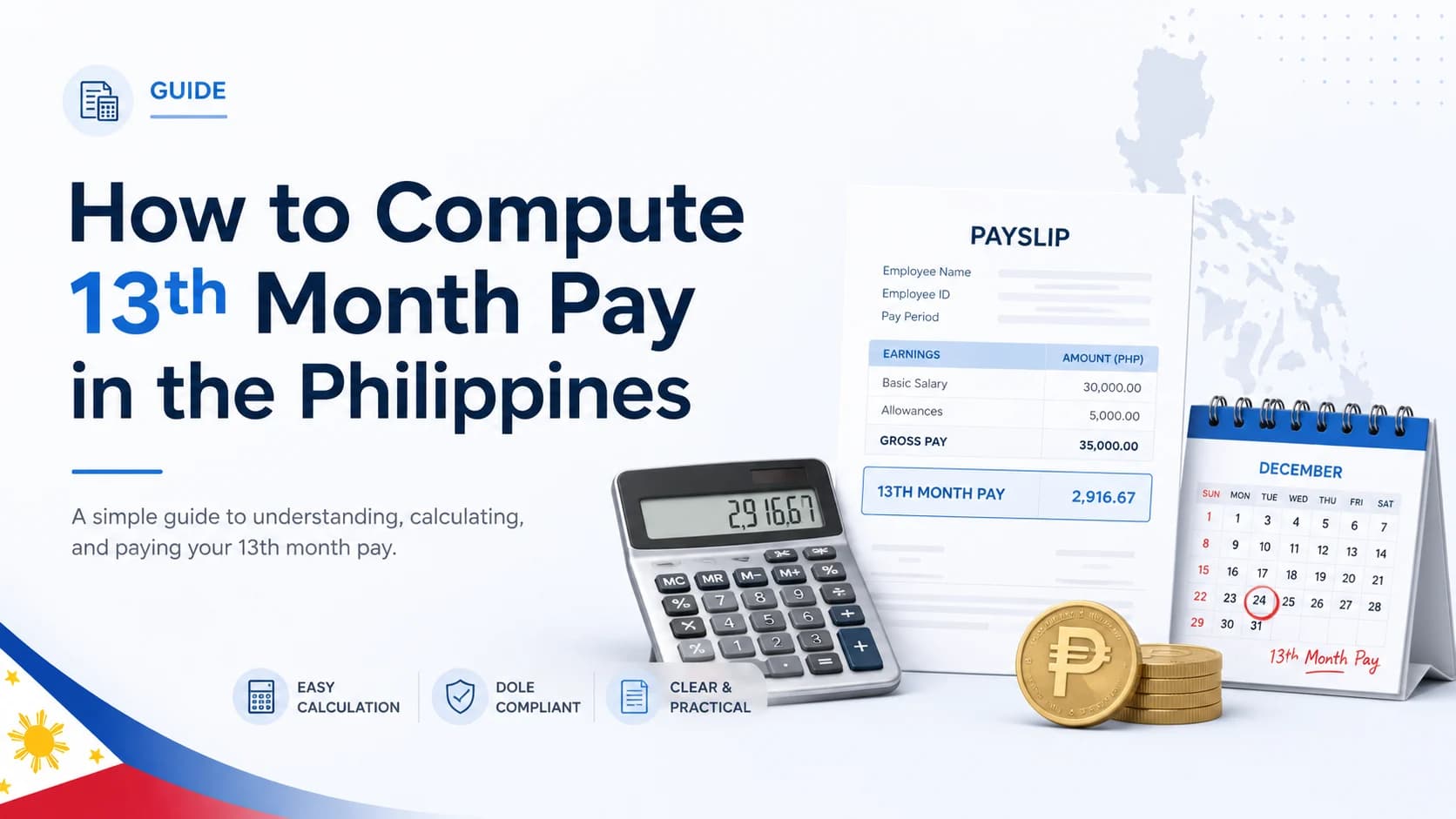
For employers hiring in the Philippines, 13th month pay is an important part of annual workforce budgeting. Although it is sometimes described informally as a bonus, it is a mandatory statutory benefit for covered private-sector employees. It is separate from any discretionary Christmas bonus, performance bonus, or annual incentive an employer may choose to provide.
What is 13th month pay?
The statutory minimum is one-twelfth of the total basic salary an employee earned during the calendar year.
13th month pay = Total basic salary earned during the calendar year ÷ 12
The calculation uses salary actually earned, rather than simply the employee's salary rate at year-end. Unpaid absences, mid-year salary increases, and partial-year employment can therefore affect the final amount.
Who is entitled to 13th month pay?
The benefit generally applies to private-sector rank-and-file employees who worked for the employer for at least one month during the calendar year, regardless of:
- Whether the employee is regular, probationary, project-based, or fixed-term
- The method used to pay wages
- Whether the employee remains employed at year-end
- Whether the employee works for more than one private employer
Employees paid by piece rate are covered. Employees who resign or are terminated before the annual payment date remain entitled to their proportionate amount.
Managerial employees are outside the statutory rank-and-file requirement, although an employer may provide the benefit through a contract, company policy, collective agreement, or established practice. Classification depends on actual authority and responsibilities, not only the job title.
How to calculate 13th month pay
Example 1: Employee worked for the full year
An employee receives a monthly basic salary of ₱60,000 and earns the same amount for all 12 months.
| Calculation | Amount |
|---|---|
| Total annual basic salary | ₱60,000 × 12 = ₱720,000 |
| 13th month pay | ₱720,000 ÷ 12 |
| Amount due | ₱60,000 |
For a full year without salary changes or unpaid absences, the employee will normally receive an amount equal to one month of basic salary.
Example 2: Employee started in July
An employee begins work on 1 July and receives a monthly basic salary of ₱60,000.
| Calculation | Amount |
|---|---|
| Basic salary earned from July to December | ₱60,000 × 6 = ₱360,000 |
| 13th month pay | ₱360,000 ÷ 12 |
| Amount due | ₱30,000 |
The amount is divided by 12, not by the number of months worked.
Example 3: Employee received a salary increase
An employee earned ₱50,000 per month from January to June and ₱60,000 per month from July to December.
| Calculation | Amount |
|---|---|
| January to June | ₱50,000 × 6 = ₱300,000 |
| July to December | ₱60,000 × 6 = ₱360,000 |
| Total basic salary earned | ₱660,000 |
| Amount due | ₱660,000 ÷ 12 = ₱55,000 |
Use the employee’s actual payroll history rather than applying the latest salary to the entire year.
What is included in basic salary?
The computation ordinarily starts with basic salary earned for services rendered. Payments generally excluded when they are not integrated into basic salary include:
- Overtime pay
- Holiday pay
- Premium pay
- Night shift differential
- Cash equivalents of unused leave
- Cost-of-living allowances
- Other allowances and monetary benefits kept separate from basic salary
An allowance or benefit may need to be included when it has been expressly integrated into basic pay through an employment agreement, collective agreement, company policy, or established practice.
Paid leave normally does not reduce the computation because basic salary continues to be paid. Unpaid absences can reduce total basic salary earned and the resulting benefit.
What about commissions?
Employees receiving a fixed or guaranteed wage plus commission remain entitled. Current DOLE guidance states that the computation uses the fixed or guaranteed basic wage, while commissions paid for additional sales efforts are generally excluded under Supreme Court jurisprudence.
Commission structures differ, so employers should verify whether any payment has been contractually integrated into basic salary before excluding it.
New hires and employees who leave during the year
A new employee who has worked for at least one month receives a proportionate amount based on basic salary earned from their start date to the payroll cut-off.
An employee who resigns or is terminated is also entitled to accrued proportionate 13th month pay as part of final pay. DOLE reiterated in January 2026 that final pay should generally be released within 30 days from separation unless a more favorable policy or agreement applies.
Are independent contractors entitled?
A genuine independent contractor is not ordinarily covered because the statutory requirement applies to qualifying employees. The contract label alone does not determine legal status.
Philippine courts consider factors including:
- Who selects and engages the worker
- Who pays the worker
- Who has the power to terminate the relationship
- Who controls how the work is performed
- The worker’s broader economic dependence on the company
The right of control is particularly important. A contractor treated operationally like an employee may create worker-classification and statutory-benefit risk.
Employers may engage a genuinely independent service provider, hire the worker directly, or use an employer-of-record or compliant local employment provider. A voluntary contractual 13th month equivalent in a contractor package is different from statutory employee entitlement.
When must it be paid?
Covered employers must pay the full required amount on or before 24 December. Payment may be split during the year, provided the complete amount is paid by the deadline. Current DOLE guidance does not allow applications for exemption or deferment.
Employers must also submit their compliance report through the DOLE online reporting system by 15 January of the following year.
Is 13th month pay taxable?
The combined value of 13th month pay and qualifying other benefits is generally exempt from income and withholding tax up to ₱90,000. Amounts above the applicable ceiling are taxable compensation. Apply the ceiling across the combined benefits rather than treating each bonus as having a separate ₱90,000 exemption.
Common mistakes employers make
- Calculating from the latest salary: Use total basic salary actually earned during the year. Do not multiply the December salary by the number of months worked when the rate changed during the year.
- Including or excluding every allowance automatically: Treatment depends on whether the payment remains separate from basic salary or has been integrated into it.
- Dividing by the months worked: The statutory formula divides total basic salary earned by 12, even when the employee worked fewer than 12 months.
- Excluding resigned employees: Employees who leave before December remain entitled to the proportionate amount accrued during their employment.
- Treating a Christmas bonus as an automatic replacement: A discretionary bonus is not automatically the statutory 13th month pay. Identify the statutory component clearly in payroll records and contracts.
- Treating every contractor as exempt: The actual working relationship matters. Misclassification can expose a business to unpaid benefit claims and other employment obligations.
Employer checklist
- Confirm which workers are employees and which are genuine contractors.
- Identify rank-and-file employees who worked for at least one month.
- Export each employee’s actual basic salary earned during the year.
- Account for salary increases and unpaid absences.
- Review allowances that may have been integrated into basic salary.
- Include accrued amounts in final pay for separated employees.
- Pay the complete amount no later than 24 December.
- Apply the combined ₱90,000 tax-exemption ceiling correctly.
- Submit the DOLE compliance report by 15 January.
Hiring in the Philippines?
Plan the role and total employment budget with confidence
Permhunt can help you benchmark salaries, define the position, and recruit qualified Philippine talent for your team.
Quick answers
Frequently asked questions
Is 13th month pay the same as a Christmas bonus?
No. The 13th month pay is a statutory benefit. A Christmas or performance bonus is generally discretionary unless required by contract, agreement, or established company practice.
Is a probationary employee entitled?
Yes, provided the employee is rank-and-file and has worked for at least one month during the calendar year.
Does an employee need to work for 12 months?
No. Employees with at least one month of service receive a proportionate amount.
Are unpaid absences deducted?
Unpaid absences reduce the basic salary actually earned, which can reduce the resulting benefit.
Can the employer pay it monthly?
Employers have flexibility in how the amount is distributed, provided the complete statutory amount is paid by the deadline and the arrangement is documented clearly in payroll and employment records.
Do resigned employees still receive it?
Yes. The employee receives one-twelfth of the total basic salary earned up to the separation date.
Sources and legal references
- DOLE / NWPC, Workers’ Statutory Monetary Benefits Handbook
- DOLE, 13th month pay guidance and deadline reminders
- DOLE, final pay and Certificate of Employment release guidance
- Supreme Court of the Philippines, employee-versus-contractor classification principles
- Bureau of Internal Revenue, Revenue Regulations No. 11-2018

About Permhunt Team
Expert in remote hiring and Filipino talent acquisition with over 10 years of experience helping companies build successful remote teams.